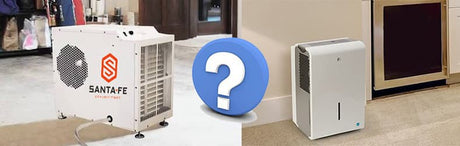
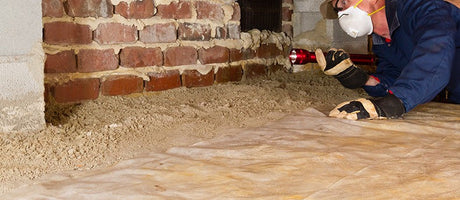
What Is a Crawl Space Dehumidifier?
You might be asking, “Can’t I just use my normal dehumidifier in my crawl space?” The answer may surprise you:
Dehumidification for crawl spaces needs specially designed systems to work in very specific environments. That makes them different from general dehumidifiers.
A dehumidifier for crawl space is designed to be compact and hands-free. It might also even feature helpful extras like remote monitoring (you don’t want to be crawling in and out of your crawl space every day!) and self-drainage.
Such specs make them 100% ideal for basements and crawl spaces.
Signs Your Crawl Space Needs a Dehumidifier
We believe every crawl space can benefit from a crawl space dehumidifier. But there are some signs that indicate you should consider getting one sooner rather than later:
- Persistent musty smells from vents or floors.
- Mold on your beams or subflooring.
- Continuous condensation on ductwork or plumbing.
- Sagging insulation or wood structures are rapidly deteriorating.
- Increased indoor allergy or respiratory issues.
- Water stains or standing water.
- Evidence of pests like termites or rodents.
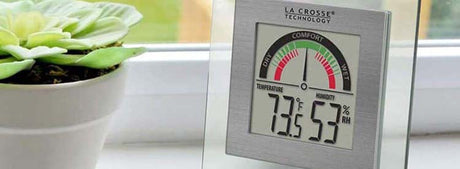
- Humidity levels in your home are above 60%.
If you’ve noticed any of these signs, it’s best to act quickly. A Sylvane crawl space dehumidification device is the easiest, most affordable solution.
How to Choose the Right Crawl Space Dehumidifier
Don’t waste time and money on the wrong crawl space dehumidifier. Take the time to explore your options and weigh up your needs:
- Crawl space size & ceiling height: Most models list their effective square footage (covering small rooms, medium rooms, and large rooms). So, find out the size of the area you want to dehumidify.
- Humidity severity: Go for models with higher pint/day capacity (70+ pints) for spaces with visible moisture or mold history.
- Drainage method: If you’d rather leave your dehumidifier to operate itself, choose a unit with an integrated pump or gravity drain system.
- Temperature tolerance: Most crawl spaces are unconditioned. This means they’re cold, so you should opt for a low-temperature model.
- Airflow design: A horizontal unit may be better for extra-tight spaces, as vertical units may not fit.
- Remote control/monitoring: These models are especially handy in hard-to-reach areas. Simply install the dehumidifier and leave it to work its magic.
- Noise level: Your crawl space might be below a busy area. If so, choose a quiet model that won’t bother you.
Installation & Placement Tips
Most of our crawl space dehumidifiers are extremely easy to set up yourself. Here are some tips:
- Always place on a flat, level surface.
- Ensure 6–12 inches of clearance around air intakes/exhausts.
- Avoid placing near insulation batts.
- Connect to a drain line routed to a sump pump or exterior outlet.
- Use a remote humidistat or control panel if the crawl space isn’t easily accessible
If you’re unsure about setting up your crawl space dehumidifier yourself, contact a professional.
Why Choose Sylvane?
We’ve been helping businesses and homeowners find the perfect air quality control equipment for over two decades. That means we hand-select all products for maximum reliability. You can count on our crawl space dehumidifier brands (like Santa Fe and Aprilaire) to deliver.
Beyond that, we also provide in-depth product guides and support to help with all sizing and installation questions, as well as world-class shipping and warranties.
Crawl Space Dehumidifier FAQs
What’s the best dehumidifier for a small crawl space?
Look for something compact and energy-efficient. The Aprilaire E070 and Santa Fe Compact70 are top choices.
Will a crawl space dehumidifier stop mold growth?
Yes, but it has to maintain a humidity level below 60%, ideally around 50%.
Can I use a regular dehumidifier in a crawl space?
Usually not. Regular dehumidifiers are often too large and can’t handle particularly high humidity.
How much does it cost to run one continuously?
It depends on the energy efficiency of the model and your electricity rates. Usually, around $20–$40 per month.
Should I seal my crawl space before installing a dehumidifier?
It’s best to. Otherwise, outside moisture will keep entering, making the dehumidifier work harder and less effectively.
How often should I check or maintain it?
Check it monthly for proper drainage and filter cleanliness. Clean or replace filters every 3–6 months and inspect for clogs or leaks.